
1. Introduction: The Sustainable Innovation Landscape and Kalyana Kumar's Quest
India generates an estimated 550 million tonnes of agricultural crop residue each year, presenting a massive organic waste management challenge that frequently culminates in environmental degradation through open field burning. Concurrently, the nation has emerged as one of the world's largest plastic waste producers, generating 9.3 million tonnes of plastic waste annually—surpassing countries such as Nigeria (3.5 million tonnes), Indonesia (3.4 million tonnes), and China (2.8 million tonnes), and accounting for 20% of global plastic waste emissions. This ecological strain is further exacerbated by the rapid growth of the online food delivery sector within the gig economy. Driven by on-demand digital platforms such as Zomato, Swiggy, Uber Eats, Blinkit, and Zepto, and facilitated by digital payment infrastructure like UPI and Paytm, the Indian online food delivery market was valued at USD 72.12 billion in 2024 and is projected to expand from USD 84.53 billion in 2025 to USD 352.72 billion by 2034. Operating at the intersection of agricultural waste valorization and urban single-use packaging mitigation, Mr. Kalyana Kumar (Kalyan Kumar) stands as a key mechanical innovator designing specialized processing equipment to transform agricultural residue into viable alternatives to single-use plastics.
Here are the contact details for SPS Kalyan Machine Designer retrieved from your sources:
Company Name: SPS Kalyan Machine Designer
Founder / Key Contact: Mr. S.P. Kalyan KumarPhone Number: +91-9597715496
Physical Address: 1/205 A, Periyamathyampalayam, Bilichi Post, Mathampallayam, Coimbatore – 641019, Tamil Nadu, India
Official Website: [spskalyanmachinedesigner.in](https://spskalyanmachinedesigner.in/)
Social Media Handles:
Facebook: @Sps-kalyan-machine-designer
LinkedIn: @sps-kalyan-machine-designers
YouTube: @spskalyanmachinedesigner
Twitter (X): @SpskalyanD
The structural challenge facing India’s food packaging sector stems from its deep reliance on synthetic petroleum-based polymers—including Low-Density Polyethylene (LDPE), High-Density Polyethylene (HDPE), Polypropylene (PP), Polyethylene Terephthalate (PET), Polyvinyl Chloride (PVC), Polystyrene (PS), and Polycarbonates (PC). Accelerated by fast-paced urban lifestyles and a higher proportion of working women, takeaway food consumption has surged, resulting in the widespread deployment of disposable plastic containers, wraps, and cutlery. When these synthetic materials degrade physically or interact with heated food items, they release primary and secondary microplastics into human food chains and aquatic ecosystems. Ingested or inhaled microplastics present severe physiological risks, inducing oxidative stress in the respiratory tract, gastrointestinal distress (including abdominal pain, bloating, and altered bowel habits), persistent contact dermatitis, and elevated risks of colorectal and pancreatic cancers. Furthermore, microplastics pass through municipal wastewater treatment infrastructure, accumulating in marine environments and disrupting aquatic food webs. Kalyan Kumar’s engineering work directly addresses both ends of this crisis: converting unmanaged rural crop residue into valuable raw inputs while reducing urban reliance on microplastic-generating single-use packaging.
Synthetic Plastic Packaging Reliance:
- Environmental Impact: Accumulation of non-biodegradable petroleum polymers contributing to 9.3 million tonnes of annual plastic waste and extensive aquatic contamination.
- Health Hazards: Consumer ingestion of microplastics linked to respiratory oxidative stress, gastrointestinal dysfunction, contact dermatitis, and digestive system malignancies.
- Market Drivers: Explosive growth of gig-economy takeaway platforms and busy urban consumer demographics.
Agri-Waste Utilization Imperatives:
- Resource Valorization: Productive utilization of India's 550 million tonnes of annual agricultural residue into functional industrial feeds.
- Circular Economy Design: Conversion of agricultural biomass (husk, bran, straw, leaves) into fully compostable bio-packaging alternatives.
- Biosecurity & Safety: Complete elimination of synthetic polymer leachates and microplastics through natural biopolymer adoption.
To translate these strategic imperatives into industrial production, Kalyan Kumar applied his mechanical engineering expertise to design specialized manufacturing machinery capable of converting raw crop residue into structured packaging solutions.
2. Technological Innovation: SPS Kalyan Machine Designers and Agri-Waste Transformation
Unlocking decentralized green manufacturing requires localized machinery innovation that enables regional entrepreneurs to process raw agricultural residue efficiently. Rather than acting solely as an end-product manufacturer, Mr. Kalyan Kumar established specialized equipment design and manufacturing enterprises in Coimbatore, Tamil Nadu—specifically SPS Kalyan Machine Designers (located in Veerapandi Pirivu / Shanthi Medu) and SPS Kalyan Enviro Power. By designing and producing machinery locally, his ventures lower capital barriers for regional producers and establish a foundation for decentralized bio-economy manufacturing.
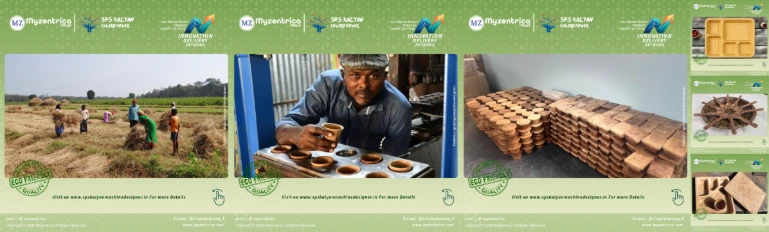
Kalyan Kumar’s machinery portfolio—which includes semi-automatic paper plate and bio-container processing units—is engineered to process a diverse pool of raw agricultural residues without requiring complex synthetic binder additives. These mechanical systems apply controlled thermal molding and mechanical pressure to transform fibrous, unrefined biomass into functional, liquid-resistant, and single-use bio-packaging items. The machinery demonstrates operational flexibility by handling an interchangeable feed of raw materials to manufacture a comprehensive range of disposable containers and cutlery.
Raw Material Inputs Pool Engineered Biodegradable Output Capabilitie
1. The First Group: Raw Materials (Agro-Waste Inputs)
- Items: Banana leaves, Wheat bran, Rice bran, Rice husk, Cereal straw, Millet waste, Blended bio-agri waste.
- Meaning: These represent discarded agricultural crop residues. SPS Kalyan’s industrial machinery is engineered to upcycle over 35 types of farm wastes that would otherwise be burned or thrown away, converting agricultural refuse into usable industrial raw material.
2. The Second Group: Finished Products (Output Applications)
- Items: Teacups, Juice & wine glasses, Water bottles, Storage flasks, Food containers, Ice cream bowls, Spoons, forks & disposable cutlery
- Meaning: These are the durable, leak-proof, and commercial end products formed from those agricultural raw materials. They serve as direct substitutes for single-use plastic (SUP) containers, cups, and tableware across the food service and packaging industries.
3. Key Technological Takeaways
- Multi-Material Versatility: Rather than requiring a separate machine for every raw material, a single SPS Kalyan machine uses interchangeable dies to process various blended organic wastes into multiple packaging shapes.
- 100% Biodegradable & Edible: The resulting tableware is non-toxic, heat-resistant, breaks down naturally in water/soil, and can even be safely consumed by cattle and livestock after use
Note: The processing equipment utilizes an adaptable multi-input mechanical design, allowing regional processing units to run single or blended agricultural biowaste streams depending on seasonal crop availability.
By providing flexible processing hardware that converts raw agricultural waste into structured containers, Kalyan Kumar’s equipment connects rural agricultural biomass supply with urban packaging demand, supporting national regulatory targets aimed at phasing out single-use plastics.
3. Macro Context and Market Integration: Fitting into India’s Green Transition
Kalyan Kumar’s equipment innovations operate within an expanding commercial market backed by active regulatory support. According to market data from Ken Research, the Indian biodegradable food packaging sector reached a valuation of USD 3.09 billion in 2024, with demand concentrated in major metropolitan centers including Mumbai, Delhi, and Bangalore. Market adoption is supported by statutory directives under the central government's Swachh Bharat Mission 2.0, initiated in 2021. This mission mandates the phase-out of single-use plastics in urban centers by 2026, supported by a national budget allocation of INR 1.41 lakh crore dedicated to sustainable waste management infrastructure and alternative materials.
In the broader landscape of Indian eco-disposable enterprise, several notable firms focus on manufacturing finished tableware from specific organic inputs:
- Qudrat (Kerala): Converts rice bran, husk, and straw into animal-safe, biodegradable tableware.
- Yash Pakka / CHUK (Uttar Pradesh): Utilizes sugarcane bagasse fiber to manufacture compostable bowls, plates, and containers.
- Pappco Greenware (Mumbai): Manufactures disposable tableware from sugarcane bagasse pulp.
- Thooshan (Tamil Nadu / Southern Region): Produces 100% biodegradable and edible plates, bowls, cups, and straws using wheat bran, rice bran, and rice husk.
- Aecoz (Bangalore): Has manufactured and distributed over 4.5 crore biodegradable packaging items (cups, bowls, lids, containers), reaching a revenue of INR 5.2 crore in 2024 while serving commercial accounts such as Lulu Hypermarkets, MTR, Milano Ice Creams, Magnolia Bakery, and Ritz-Carlton.
A comparative financial evaluation of the end-product bio-packaging sector reveals a wide range of operational scale across Indian enterprises in FY 2023–24:
|
While large capital-intensive manufacturers like Bhagirath Industries (₹102.73 Cr) and Ecoware (₹32.63 Cr) operate centralized production facilities, smaller niche producers like Pappco Greenware (₹1.52 Cr), Zerocircle (₹2.10 Cr), and Biogreen (₹4.38 Cr) often face capital constraints when attempting to scale finished goods output nationwide. This financial landscape highlights the strategic value of Kalyan Kumar’s model through SPS Kalyan Machine Designers and SPS Kalyan Enviro Power. Rather than competing purely in end-product supply, his venture supplies localized machinery to third-party entrepreneurs. This B2B infrastructure approach enables small-to-mid-sized enterprises to set up decentralized production units at lower capital expense, expanding overall manufacturing capacity across the supply chain.
"Under Swachh Bharat Mission 2.0 (introduced in 2021), the Indian government has prioritized biodegradable packaging with a target to phase out single-use plastics in urban areas by 2026, backed by a dedicated waste management budget of INR 1.41 lakh crore. These statutory measures, combined with an Indian biodegradable food packaging market valued at USD 3.09 billion in 2024, generate powerful demand tailwinds for specialized processing machinery."
As statutory restrictions on conventional plastics tighten, machinery providers like SPS Kalyan Machine Designers furnish the foundational tooling required to scale bio-packaging production across regional markets.
4. Conclusion & Strategic Outlook:
The Future of Eco-Friendly Industrial Machinery Mr. Kalyana Kumar’s machine engineering approach provides a practical model for circular bio-economy manufacturing, turning an environmental challenge—India's 550 million tonnes of annual crop residue—into an industrial resource. By supplying processing machinery to third-party manufacturers, his enterprises facilitate scalable, decentralized production that addresses plastic pollution at the supply chain level.
Data compiled in the Central Pollution Control Board (CPCB) compendium indicates that Tamil Nadu is building significant capacity in this sector, hosting 611 registered manufacturers and sellers of single-use plastic alternatives out of 2,867 total entities identified nationwide. Kalyan Kumar’s machine design enterprise provides the processing machinery needed to support this regional growth, driving local entrepreneurship, supporting industrial employment, and supplying sustainable packaging alternatives for the expanding gig economy.
Key Strategic Takeaways
1. Infrastructure-Centric Ecosystem Enablement: By manufacturing bio-waste processing equipment (via SPS Kalyan Machine Designers and SPS Kalyan Enviro Power) rather than focusing exclusively on finished tableware supply, Kalyan Kumar provides the equipment foundation for independent entrepreneurs to build localized, low-capital packaging units.
2. Dual-Ended Environmental Impact: The machinery targets two distinct ecological challenges: it reduces agricultural field burning by utilizing crop residue (drawing from India's 550 million tonnes generated annually) while providing functional bioplastic alternatives to mitigate the nation's 9.3 million tonnes of annual plastic waste.
3. Policy Integration and Market Capitalization: Kalyan Kumar's machinery directly supports Swachh Bharat Mission 2.0 objectives (phasing out urban single-use plastics by 2026 under an INR 1.41 lakh crore budget allocation) and capitalizes on the growing USD 3.09 billion domestic biodegradable food packaging market.
4. Mitigation of Microplastic Health Risks: Processing machinery that converts crop residue into 100% natural, additive-free containers reduces consumer exposure to synthetic polymers (LDPE, HDPE, PP, PVC, PS), helping lower the health risks associated with microplastic ingestion, including respiratory stress, contact dermatitis, and gastrointestinal cancers.